No, this isn’t about mowing the lawn at Magnolia, although I have undying respect for the people that regularly do this daunting chore.
Findagrave.com is the undisputed king of online cemetery websites. Their database has close to a quarter of a billion graves, and the database grows by five to ten thousand every day. It’s a superb example of crowdsourcing, and it can be a genealogist’s best friend.
Findagrave can also be a historian’s worst nightmare.
Because the entry and curation of data in Findagrave is done entirely by volunteers, it varies widely in quality and completeness. It’s common for people to carefully maintain the Findagrave memorials for their close friends and family, but that usually represents a tiny fraction of a cemetery’s population.
Findagrave’s entries for Magnolia Cemetery have been compete-ish for some time now (thanks to a small and dedicated group of Baton Rouge volunteers), but most of the graves hadn’t been geotagged. For the uninitiated, this means tagging the exact location of the grave, such that a person visiting Magnolia could navigate to within a foot or two of any particular grave in the cemetery.
If you’ve ever thought to yourself, “I’ll just wander around the graveyard until I find Great Uncle George’s grave,” then you can certainly understand the benefit of geotagging. Magnolia spans about 10 acres, and walking past every grave can take days.
Wondering how I know this?
In the world of Findagrave volunteers, “mowing” is a term that means to walk a cemetery from end-to-end, with camera (phone) in hand, carefully photographing and geotagging each grave.
And yes, it’s as laborious and tedious as it sounds.
Magnolia Cemetery has bedeviled me for years. I drive past it at least several times a week. Like any bred-in-the-bone historian, there’s a constant yearning to go in and walk among the cemetery’s storied residents—many of whom probably haven’t had visitors in decades. I’m also aware that Magnolia lives in one of Baton Rouge’s complex liminal spaces, where two fundamentally different cities abut one another. The evidence of this is profoundly uncomfortable: towering monuments to the city’s once-wealthy patrons offer shade and shelter to some of our city’s poorest and most destitute. This particular piques frequent glances over one’s shoulder during a long Saturday afternoon stroll through Magnolia.
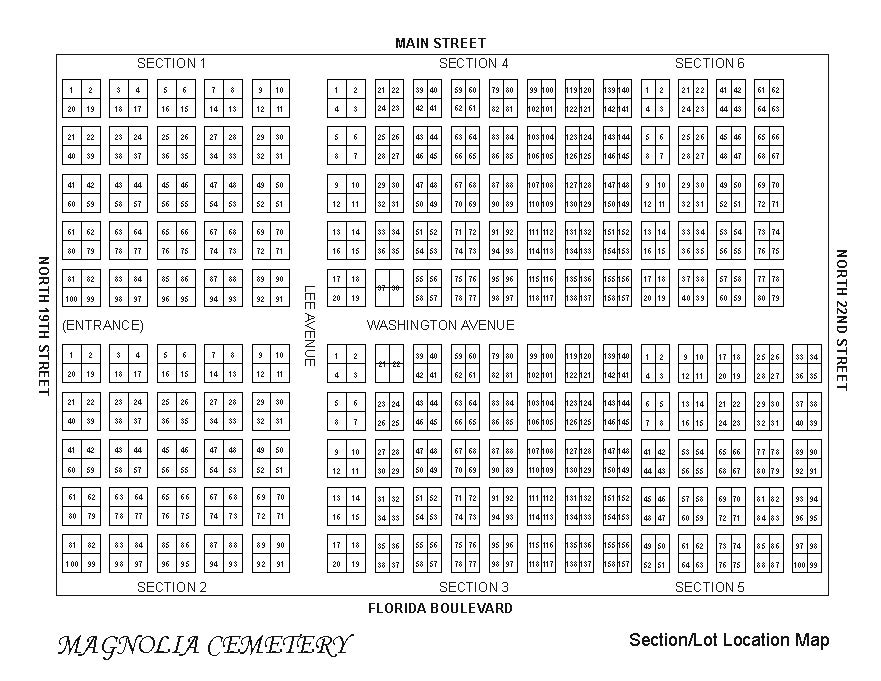
Thankfully, Magnolia is laid out in a nearly perfect grid—a benefit of having been built well outside of the city when the city was still a toddler and things could be kept orderly.
Being a reasonably logical person, I decided to start at Section 1, Lot 1, and mow away. Here’s a particularly notable person I (figuratively) tripped over.
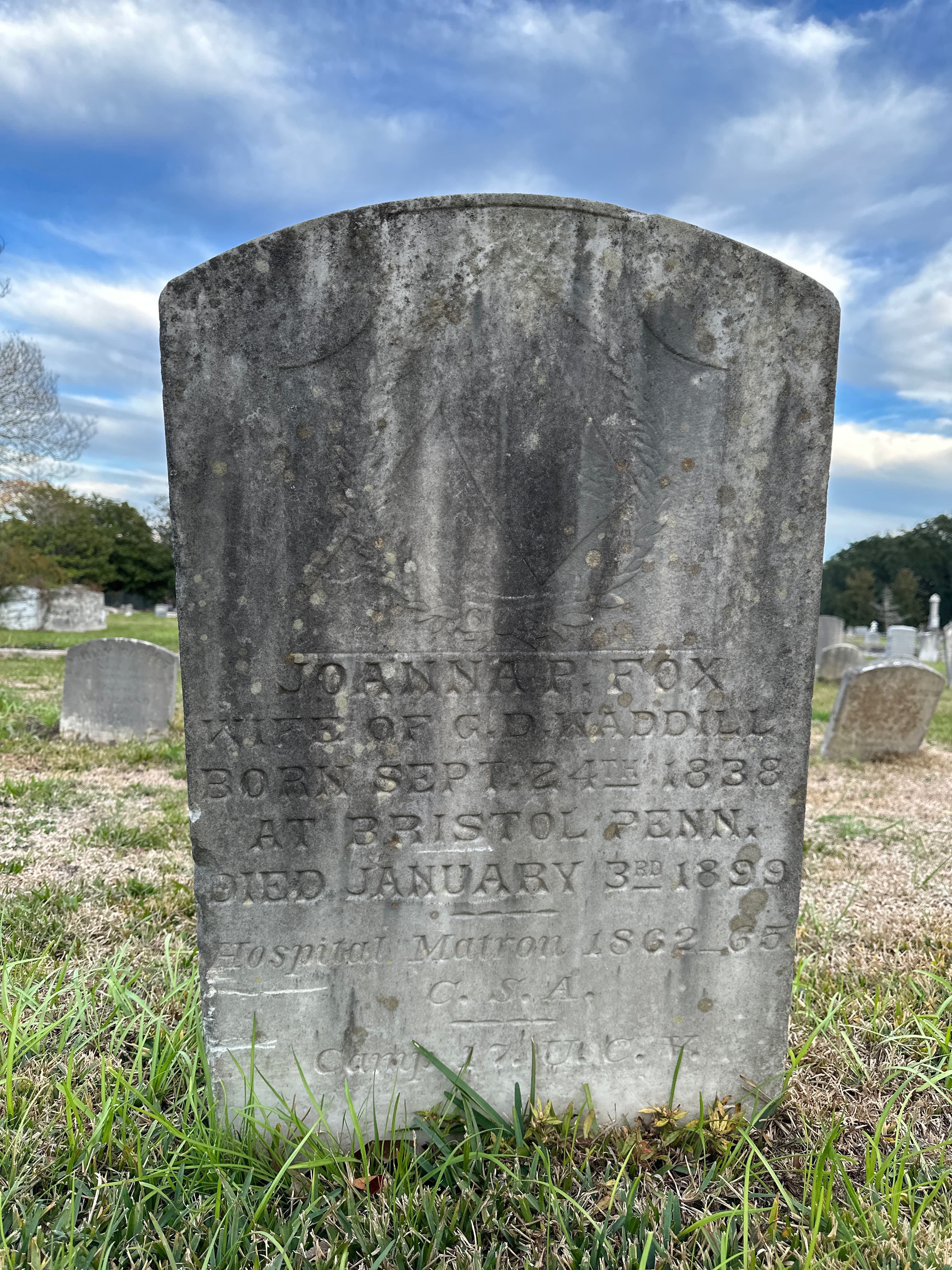
Joanna Fox Waddill
Like so many Antebellum Americans, Joanna was born in the northeast—Bristol, Pennsylvania, to be precise—before moving south. Her father, James Coleman Fox (1806 – 1856), was a brickmaker that decided the family would find its fortunes in Natchez, Mississippi. By the 1850 federal census, he was living there with his wife Catherine, their son Benjamin, Joanna (the subject of this article), and three other children.

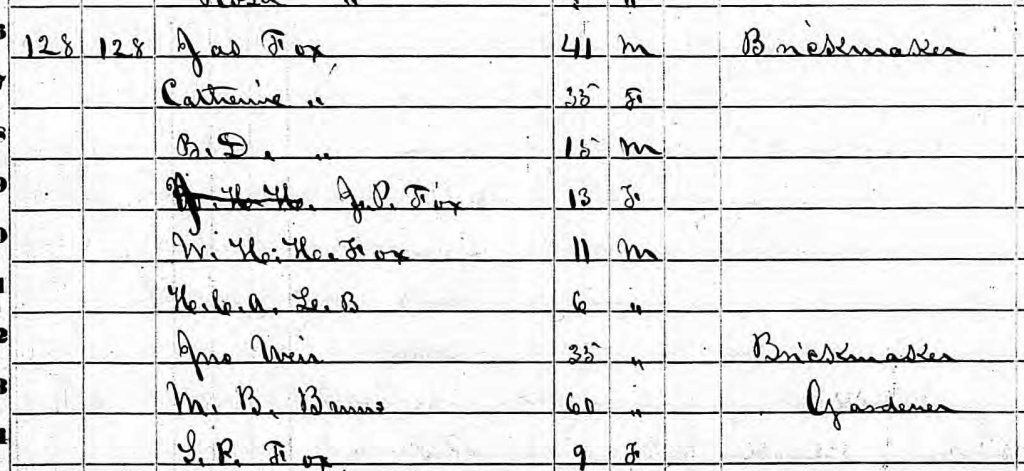
The Civil War was a terrible thing, and the Fox family was among the hundreds of thousands that mourned the loss of a beloved child and sibling. Several years before this loss shook the Fox family, Joanna was doing remarkable work. Here’s her obituary from 1899:
A NOTABLE WOMAN.
There died in this city yesterday morning a quiet and unassuming lady about whose kindly deeds and gentle ministrations not much has been said, but whose presence on the battle fields and in the hospitals thirty-five years ago brought comfort and solace to many wounded and dying soldiers; the brazen flare of trumpets heralded not the story her deeds to the world nor did she seek the vulgar notoriety of the public press but with heart devoted to the cause she loved, like an angel of mercy her unostentatious service was freely given wherever needed. The woman of whom we write is Mrs. Joanna P. Waddill, and the record of her humble deeds is such as Florence Nightingale might have envied or Clara Barton emulated. Mrs. Waddill’s ministrations in camp and field and hospital were not conducted with the knowledge that at her back was a rich and powerful government ready to respond to her every wish, nor did she go with train loads of hospital supplies at her command but with a heart filled with the pure gold of love and loyalty, with a soul rich in sympathy for distress this brave, pure Southern woman gave the best years of her young life to the alleviation of the suffering of her country’s defenders. Truly has there passed from among us a Mother in Israel, one whose beautiful character and modest demeanor should serve as a model for future generations! Of her life and record we clip the following from the Evening Truth of this city whose venerable editor was personally familiar with Mrs. Waddill’s heroic self sacrifice:
“Mrs. Waddill’s maiden name was Fox and she was a native of Natchez, Miss. In the Natchez Rifles, which became a portion of John McEnery’s Louisiana Battalion, she had brothers and kinsmen, and when news came back home that in the shock of battle many of her friends had been wounded, this sweet and charitable woman offered her services as hospital nurse, and faithfully did she perform her self-imposed duty, until the ending of our dream of triumph. Not only did she remain until the general surrender, but she stood at her post until the last wounded soldier had left for home or had died.
“Neither hardship, suffering nor defeat caused this brave and gentle soul to lessen her love for the Southland and Its soldiers. Many of her friends and kindred fell upon the gory field of battle, among whom was her brother, Lieut. Fox, but undaunted she persevered in her work of love.
“At the time of her death, and for many years previous, Mrs. Waddill was president of the Ladies’ Veteran Aid Society and was the only female member of a camp of U. C. V. Her membership was in Camp No. 17, of this city, and it had none more devoted nor enthusiastic.
“This good woman lived to the age of 60, and at no time was she ever known to close her ears to the cry of distress or to fail to succor the needy.
“The writer knew the deceased under the most trying circumstances and knows whereof he speaks when he pronounces her to have been the soldier’s comfort and the orphan’s refuge more prominently than any woman he ever knew.
“She fell into death’s embraces as quietly and peacefully as if in gentle sleep, and is now reaping the reward of a life spent in doing good to others.
“Sleep, gentle spirit, sleep: the memory of your virtues will survive in the hearts of your friends and comrades as long as life endures.”2
Read today, that obituary is very much a product of 1899. “The cause she loved,” “the ending of our dream of triumph,” and “a Mother in Israel” are the unmistakable language of the Lost Cause, when the men of the U.C.V. camps were busy turning the war into marble—and a modest, saintly Confederate nurse suited that project perfectly.
(The Evening Truth’s editor also had her as a native of Natchez—so much the better for our Southern heroines to be Southern-born.)
Set the rhetoric aside, though, and the core of the story holds up. A young woman in Natchez heard that men she knew had been hurt, and she went to take care of them. We get a glimpse of how that kind of news reached her: among George Waddill’s papers at LSU is a letter written to “Joanna Fox of Natchez” from Corinth, Mississippi, describing the Battle of Shiloh.3 And once she went, she stayed. The obituary is very clear that she didn’t leave until the last of her patients had gone home or died.
This is where the story gets tougher.
By the fall of 1863, Joanna had been at this work for a few years. She knew what a casualty list meant to the people waiting at home, because she’d written plenty of those letters. Then, in September, the war came for her own family. Her older brother, Lieutenant Benjamin Duncan Fox, was killed at the Battle of Chickamauga. He was 29.
Think about what a nurse did in those hospitals. Beyond dressing wounds, she made sure the dying weren’t nameless. She took down last words, wrote to mothers, and saw that a man was buried and not just disposed of. Joanna did that for strangers’ sons and brothers for years, and no one was able to do it for hers. Benjamin’s grave is lost. Like thousands of Confederates who fell at Chickamauga, he most likely went into a trench or an unmarked grave near where he died, and the record of where he lies went with him.
The Fox family’s graves tell the rest. Three of the five children lie with their parents in the Natchez City Cemetery, and none of those stones mentions Benjamin. Joanna rests here at Magnolia, next to her husband, George D. Waddill, a Baton Rouge druggist who served as a Confederate hospital steward. The two met at the military hospital at Lauderdale, Mississippi, and married there on September 26, 1864, about a year after Chickamauga. They had planned to wait until the war was over, but her brother Billy was in Lauderdale, and they didn’t want to miss the chance to have family at the wedding. Joanna wrote to her mother afterward, a little sheepishly, that her one regret was that Ma hadn’t been there to see it.4
She never stopped doing the work that brought them together. For many years she was president of the Ladies’ Veteran Aid Society, and she held the unusual distinction of being the only woman admitted to U.C.V. Camp No. 17. She couldn’t save her brother, so she spent the next thirty-five years looking after the men who did come home (many of whom rest in the same cemetery).
Which brings me back to mowing.
Joanna’s grave now has a photo and a geotag. Anyone who wants to pay their respects can walk straight to it, to within a foot or two, without spending a Saturday wandering the grid. That’s the whole point of this tedious exercise: making the dead findable again.
There’s no pin to drop for Benjamin. As far as I can tell, his only memorial is one line in his sister’s obituary, published thirty-five years after he died: among whom was her brother, Lieut. Fox. She spent the war making sure that men who died far from home weren’t forgotten, and in the end she did the same for him.
More finds from the mow to come.
note: at this point I’ve mowed about 80% of Magnolia Cemetery. The cemetery map shows what is done, and it should be clear that I’ve still got work to do in sections 3 and 5. Even when I’m “done,” there will still be much to do, as many of the graves were either never marked, or no longer have visible markers. Such are some of the many challenges of 150+ year old cemteries.
- 1850 Federal Census, Natchez (South), Adams County, Mississippi, page 16 of 33. ↩︎
- The Daily Advocate, Wednesday, January 4, 1899, Page 2 ↩︎
- George D. Waddill Papers, Mss. 891, 893, Louisiana and Lower Mississippi Valley Collections, LSU Libraries Special Collections. ↩︎
- Joanna Painter Fox Waddill to her mother, October 14, 1864, Waddill Family Papers, Mss. 4578, LSU Libraries Special Collections. Quoted in Tara Zachary Laver, “Civil War Treasures: Love Is a Battlefield: Courtship and Marriage in the Civil War,” Civil War Book Review 16, no. 1 (Winter 2014). ↩︎